
 By
By 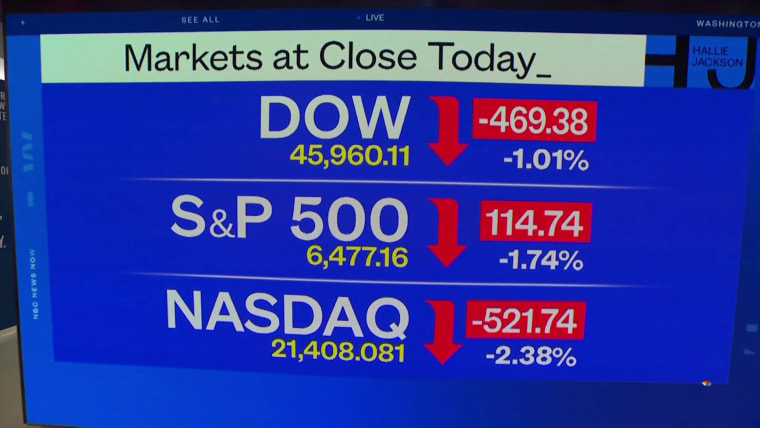
U.S. stocks and bonds sold off Thursday and oil continued its weekslong upward trajectory, as optimism faded about possible peace talks or a U.S.-Iran ceasefire.
The price of U.S. crude oil rose near $95 per barrel, up more than 4%. International Brent crude rose 5%, to more than $109 per barrel. Since the war started, the cost of U.S. crude oil is up more than 40%. Since the start of the year, it has risen more than 60%.
The S&P 500 closed down by 1.7%, the Dow tumbled 470 points and the Russell 2000 ended the day down 1.7%. For the S&P 500, Thursday was its worst single day since the war began.
The Nasdaq Composite fared the worst though, and dropped nearly 2.4%, pushing the index into correction territory. A correction is when an index falls 10% or more from its most recent all-time high. As of Thursday’s close, the index is now down 10.9% from its October high.
Heating oil, a proxy for jet fuel prices, also spiked 8% on Thursday afternoon. The nationwide average price of unleaded gas was $3.98 a gallon.
Nonetheless, Trump downplayed the severity of the oil and gas price spikes.
Energy prices “have not gone up as much as I thought,” Trump said at a Cabinet meeting in Washington.
The military campaign is “not over, so maybe it’ll go up a little bit more,” Trump said. “It’s all going to come back down to where it was and probably lower.”
Trump also cast doubt on a deal with Iran. “They are begging to work out a deal,” he said. “I don’t know if we’ll be able to do that. I don’t know if we’re willing to do that.”
But analysts widely believe that oil prices will continue to remain elevated over the long run, factoring in the risk that shippers will now have to assume for oil tankers that transit through the Strait of Hormuz.
Also impacting market sentiment was a report from the Organisation for Economic Co-operation and Development, which predicted that as a result of the war with Iran, the average inflation rate for G20 countries this year would rise to 4%, up from its December prediction of 2.8%. The United States is a member of the OECD.
Bonds also sold off, driving yields higher. The 10-year U.S. Treasury bond yield rose to 4.42%. The yield on 20-year bond hit 4.97% and the 30-year yield hit 4.93%.
Treasury yields, especially for the 10-year bond, heavily influence consumer lending rates. As a result, mortgage rates have risen from around 6% at the start of the war on Feb. 28 to more than 6.5% as of Thursday afternoon.
Stock indexes in Asia had already begun to sell off overnight. China’s Shanghai index and Hong Kong’s Hang Seng index both fell 1%, while Korea’s Kospi slid 3.2%.
These indexes were also weighed down by big drops in shares of tech companies, including Samsung, after Google revealed a new, more efficient use of storage and memory systems for artificial intelligence.
The Stoxx 600 in Europe followed, closing down more than 1%. Flagship stock indexes in Germany, France and the U.K. also ended the trading session down by around 1%.
